
Agentic AI for Sales: The C-Suite Playbook for 2026

Updated: May 26
May 25, 2026 | Artificial Intelligence | Sales Transformation By Kapil Nagpal and Priyanka Nagpal

Agentic AI for sales is the shift from AI that helps a rep write a better email to AI that runs the work the rep was never going to get to anyway - research, qualification, follow-up, CRM hygiene, deal nudges, without waiting for a human prompt at each step. It's the natural next chapter of the AI agent shift we covered last year, now landing specifically inside the commercial motion. Autonomous sales software, AI-driven lead qualification, and predictive sales analytics are no longer separate categories; they are converging into a single agentic layer that runs alongside human sellers.
The category is real. The proof is emerging. The failure rate is also real: 95% of enterprise generative AI pilots deliver no measurable P&L impact, per MIT, and Gartner expects more than 40% of agentic AI projects to be cancelled by the end of 2027.
This is not a problem with one answer. Sales is a layered system, and so is the path through it. The leaders pulling ahead in 2026 are not the ones buying the most agents. They are the ones who name the revenue leak first, design the human handoff with intent, and measure every dollar of outcome from week one.
The question is no longer whether agentic AI belongs in your sales motion. It does. The question is which part of your sales motion is bleeding revenue that an agent could stop tomorrow, and what you are willing to redesign to make that real.
What is agentic AI for sales?
Agentic AI for sales refers to AI systems that can take a sales goal, plan the steps to achieve it, take actions across CRM and adjacent systems, and adapt based on what comes back, with minimal human prompting per step.
It is the difference between an assistant that helps a rep do work and a digital colleague that does the work and hands off only the parts that need a human.
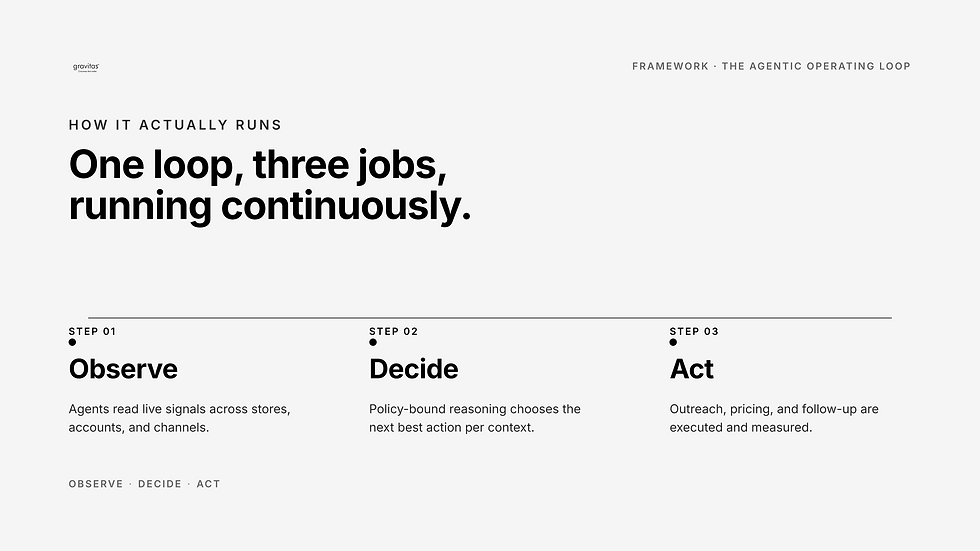
Three traits define it, and the definition is consistent across MIT Sloan, Gartner, and the major platform vendors:
Contextual. The agent interprets intent and environment, not just rules. It reads the lead's last engagement, the account's intent signals, and the rep's current pipeline before it acts.
Autonomous. It initiates and completes workflows. It does not sit and wait for a click.
Adaptive. It learns from outcomes, which messages converted, which qualification heuristics held, which follow-up timing worked, and refines.
Generative AI sits on top of the CRM as a writing assistant. Agentic AI sits upstream of the CRM. It does the research, the qualification, the drafting, and the routing, and pushes execution-ready work into the CRM record before the rep ever opens it.
Generative AI made reps faster at typing. Agentic AI is what makes the pipeline move when the rep is asleep.
A note of caution. Gartner has flagged what it calls "agent washing", the rebranding of chatbots, RPA, and assistants as "agentic AI." The firm estimates that out of thousands of vendors making the claim, roughly 130 are real. If a tool requires a human to start the loop and end the loop, it is not an agent. It is a button.

Academic research on autonomous sales software has formalized this as the perceive–reason–act (PRA) loop: the agent perceives signals from connected systems (CRM, email, intent data, web behavior), reasons over them against an explicit goal (qualify this lead, advance this deal), and acts inside the software environment to execute the next step. The PRA loop is the technical mechanism that turns AI-driven lead qualification and predictive sales analytics from dashboards a rep has to read into workflows that run themselves.
Why now: the 2026 inflection
Three things changed in the last twelve months that turned agentic AI from a category to a buying conversation.

The platforms shipped.
Salesforce Agentforce closed 29,000 deals and crossed $800M in ARR by the end of its fiscal year 2026, with year-over-year growth of 169%. The average enterprise now runs 12 AI agents, with that number projected to grow 67% in two years, according to Salesforce's 2026 Connectivity Report.
The numbers showed up.
Gartner now forecasts that 40% of enterprise applications will include task-specific AI agents by the end of 2026, up from less than 5% in 2025. Bain estimates that early sales deployments are producing 30%+ improvements in win rates where the underlying process has been rethought. We are seeing a 5.8x ROI on AI investment within 14 months of production deployment, though only about 25% of initiatives actually deliver the ROI they expected.
If your customer is starting in an LLM and your sales team is starting in a spreadsheet, the gap is already widening.
The buyer changed, too.
Bain's 2026 consumer research finds that 44% of U.S. online buyers now start their journey inside a large language model or split their search between AI and traditional engines. Up to 25% of referral traffic for some retailers now comes from AI assistants. For B2B, the pattern is the same: buyers build their vendor short lists inside LLMs before a salesperson ever picks up the phone.
Where agentic AI actually changes the sales lifecycle
The hype talks about transformation. The deployments that work talk about workflows. Eight categories show up consistently:
Account research and prospecting. Agents research target accounts, validate firmographic and intent signals, and build outreach context. At Aqfer, account research time per strategic account dropped from 4 to 5 hours to 11 to 12 minutes using an agentic GTM workspace, at the same depth.
Lead qualification and routing. The single highest-ROI use case. Agents score and filter leads against ICP and intent signals in real time, then route only sales-ready leads to humans. This is where most of the documented breakout outcomes live, and it's the pattern we see most often in QSR and fast casual franchise development.
Outreach orchestration. Multi-channel sequencing across email, LinkedIn, SMS, and chat, with personalization adjusted based on response signals, rather than static drip campaigns.
Pipeline hygiene and CRM data quality. Agents log activities, update stages, enrich records, and flag stale deals. Reps lose roughly 70% of their day to non-selling work; this is the slice agents reclaim first.
Deal progression and follow-up. Context-rich nudges on stalled deals, next-step coordination, and recovery sequences when a buyer goes quiet.
Quote-to-close and proposal generation. Pricing assembly, configuration validation, case study insertion, executive summary drafting - the assembly work, not the relationship work.
Forecasting and pipeline intelligence. Real-time, signal-based forecasts that update continuously, replacing the manual spreadsheet roll-up that takes a sales ops team three days a quarter.
Coaching and enablement. Role-play agents simulating buyer objections, content recommendation engines, and post-call review.
The pattern that matters: the highest returns concentrate where the work is repetitive, high-volume, rule-governed, and currently being done badly or not at all. Agents are not good replacements for judgment. They are excellent replacements for triage.
AI qualifies. Humans close. The handoff is the product.
What the measurable outcomes actually look like
The right way to evaluate agentic AI for sales is to tie each workflow to a specific outcome metric and a credible analyst-attributed benchmark. The table below maps the most-cited measurement categories to the ranges that show up in independent research (Gravitas, Bain, MIT, McKinsey, Gartner, Salesforce), not vendor PR.
Outcome category | What to measure | Observed range from named deployments |
Pipeline velocity | Time from lead creation to qualified conversation | 2–3x faster (Bain Technology Report 2025; multiple QSR/B2B cases) |
Win rate | Closed-won opportunities ÷ qualified opportunities | 30%+ lift where process is redesigned, not just automated (Bain) |
Lead response time | Minutes from inquiry to first qualified contact | 47 hours → under 10 minutes in production deployments (2026 case data) |
Qualified pipeline lift | Volume of sales-ready conversations per week | +200–300% in lead qualification deployments (Gravitas Blaze Pizza; B2B SaaS cases) |
Rep selling time | % of rep day spent on revenue-generating activity | 30–40% increase as admin and CRM hygiene work is offloaded |
Cost per acquisition | Fully-loaded cost per qualified opportunity | 20–40% reduction (MIT NANDA report, validated cases) |
Sales-influenced revenue | Revenue attributable to AI-supported workflows | $262B agentic-influenced spend in 2025 holiday alone (Salesforce); +59% sales growth for brands with shopper agents vs. those without |
The metrics are a framework, not a guarantee. Actual outcomes depend on data quality, the specific workflow chosen, the depth of CRM integration, and how seriously the human handoff is designed. The teams that pre-define which two or three metrics they will hold themselves to, before the agent goes live, are the same teams that show measurable lift inside 90 days.
What this looks like in retail, CPG, and QSR
The "Agentic AI for Sales" conversation gets framed almost entirely around B2B SaaS. That framing misses the most consequential shift happening right now: in retail, CPG, and quick-service restaurants, sales is being rewired on two sides at once.

On the customer side, the buyer is becoming an agent.
Around 30% of U.S. consumers now use generative AI for product comparison and recommendation, per Bain Consumer Lab. Salesforce data on the 2025 holiday season tells the rest of the story: AI influenced $262 billion of global online holiday spend, and brands that deployed shopper agents saw 6.2% sales growth versus 3.9% for brands that did not, a 59% lift attributable to the agent layer. The agentic conversation rate jumped 66% between November and December, and the rate of autonomous actions taken by those agents rose 142%.
On the sales side, the brand is becoming an operator.
This is where the most useful named examples live.

PepsiCo and Salesforce Agentforce.

The most significant CPG case in the public domain. PepsiCo is one of the first major food and beverage companies to deploy Agentforce at scale across sales, customer service, marketing, and supply chain. The deployment targets B2B portal self-service ordering with real-time inventory transparency, field-rep enablement with live in-store execution data, predictive replenishment for direct-store delivery, and a unified trade promotion management tool.
The framing from PepsiCo's chief strategy and transformation officer, Athina Kanioura, is direct: "We're deploying Agentforce in key areas like sales, customer experience, and engagement, where AI agents handle routine, repeatable tasks, freeing our people to focus on strategic work that drives the business forward."
The analyst's observation is worth keeping in mind: Coca-Cola is using AI to create desire. PepsiCo is using it to translate desire into a purchase at the shelf.
Williams-Sonoma deployed Agentforce 360 across its brand portfolio in October 2025.

The customer-service agent, internally named Olive, now handles approximately 60% of conversations on company websites, with the company targeting autonomous resolution of more than 60% of chat inquiries.
The strategic note from Williams-Sonoma's leadership is the one worth reading twice: "We're really driving share of wallet, we're driving average order values." The agent is not just deflecting service cost. It is operating as a sales surface.
Lennar built LISA: the Lennar Internet Sales Agent.
LISA handles tens of thousands of incoming leads per week, answers questions, books home tours, and creates leads through SMS and web chat. If a Lennar Internet Sales Consultant starts a conversation during the day and the buyer goes quiet, LISA picks it up after hours and keeps the conversation alive. Strict Fair Housing Act guardrails are built into the system. The structural lesson is the one franchise developers and multi-unit retailers should pay attention to: the agent does not replace the human seller. It refuses to let the lead go cold while the human is asleep.
Goodyear, Camping World, Grupo Falabella, and OpenTable round out the publicly documented retail and consumer roster, each deploying Agentforce against a different sales workflow: third-party partner opportunity surfacing, cold-lead reactivation for higher-end vehicles, 24/7 WhatsApp service and sales, and AI-led reservations handoffs.

This is where Gravitas's own data joins the conversation. A national QSR client deployed an AI-driven franchise lead qualification system through our Growth Hero™ platform. Within 10 weeks: a 300% increase in qualified franchise lead conversations, 3x faster sales velocity, three new franchise agreements signed, and a 36-month backlog of unqualified inquiries fully cleared. The team had previously been so buried in manual triage that they were not making sales calls. After deployment, they were running 30+ qualified calls a week. Read the full case study →
The CDO of that brand summarized it cleanly: "This isn't just about efficiency. The AI is doing the work of what would've taken a large team, which allows our people to focus on selling, building relationships, and driving real growth."
(For more on how he thinks about franchise growth and operator economics, Kevin Moran joined the Gravitas Podcast to talk about what separates good franchise operators from great partners.)
The pattern across PepsiCo, Williams-Sonoma, Lennar, and the QSR brands we've worked with is the same: pick the friction point that is bleeding revenue, build the agent against that one job, and design the human handoff with intent.
For franchise development teams specifically, the friction point is almost always the 72-hour window after a franchise inquiry, where conversion likelihood collapses from 95% to under 15% if no one responds.

The honest counterpoint: why most agentic AI projects don't deliver
A C-suite article that does not address the failure rate has nothing useful to say.
MIT's Project NANDA report, The GenAI Divide: State of AI in Business 2025, found that 95% of enterprise generative AI pilots delivered no measurable P&L impact. Gartner expects more than 40% of agentic AI projects to be cancelled by the end of 2027 due to escalating costs, unclear business value, or inadequate risk controls. McKinsey's State of AI 2025 reports that less than 10% of organizations have actually scaled AI agents in any individual function. By 2028, Gartner forecasts that AI agents will outnumber human sellers by 10 to 1, but fewer than 40% of sellers will report that those agents improved their productivity.
These numbers are not arguments against agentic AI. They are arguments against the way most companies are doing it.
The patterns inside the 5% that succeed are consistent across Gravitas, MIT, Bain, McKinsey, and Forrester:
Process redesign, not process automation. Automating a mediocre process produces a faster mediocre outcome. Win rates lift when the underlying sales motion is rethought, not when the existing motion is sped up.
Domain-specific over generalist. Off-the-shelf scoring models are what every competitor already has. The moat is in agents trained on a brand's own ICP, financial thresholds, territory map, and conversion patterns. MIT's data: vendor-built specialized solutions succeed roughly twice as often as internal generalist builds.
Single-workflow start, not platform sprawl. The companies hitting the 90-day-to-impact window picked one execution gap. The companies stuck at month nine launched five agents at once.
Human-in-the-loop by design. Klarna's AI agent famously handled the equivalent of 700 full-time customer service employees and was credited with $40M in profit improvement. The company then reversed course on its AI-only strategy when complex and emotionally charged conversations needed human judgment but the agent could not reliably supply. The lesson is not "do not deploy agents." The lesson is to design the handoff before you scale the agent.
Data foundation first. 52% of organizations cite data quality as the single biggest blocker to agent deployment. Safari365, a 35-person African tour operator that deployed Agentforce in six weeks, said publicly that the data cleanup took longer than the agent build itself.
The 5% that succeed are not smarter. They picked one bleed, fixed the data underneath it, designed the handoff, and measured the outcome from week one.
The platform decision: Agentforce, Copilot, or something else
For most enterprise sales leaders, the platform question collapses to two names. The answer almost always depends on where your existing estate already lives.

Salesforce Agentforce sits natively on top of Sales Cloud, Service Cloud, and Data Cloud. It is built around the Atlas Reasoning Engine and the Einstein 1 platform. Agents operate inside the Salesforce trust boundary, with field-level security, sharing rules, and profile-based access applying to what the agent can see and do. The strongest case for Agentforce is when your customer record already lives in Salesforce, and your primary use case is autonomous CRM process execution, qualifying leads, routing cases, advancing opportunities, and maintaining hygiene. Pricing is per conversation (approximately $2) or via Flex Credits.

Microsoft Copilot Studio sits across the Microsoft 365 ecosystem: Outlook, Teams, Word, SharePoint, and Dynamics 365. It is positioned as the configuration plane for any agent that runs against Microsoft data and apps. The strongest case for Copilot is when your sales team lives in Outlook and Teams, your reporting lives in Power BI, and your data lives in Dataverse. Pricing is credit-based (roughly $0.01 per message).
The honest answer most enterprise CIOs settle on is both: Copilot handles the productivity surface (email enrichment, meeting summaries, document drafting), and Agentforce handles the CRM workflow execution (qualification, routing, deal progression). The connector boundary between them is the place where governance gets hard.
Greenfield buyers should pick an existing estate gravity. Salesforce-first organizations get the integration depth they need with Agentforce. Microsoft-first organizations get the same with Copilot Studio. The platforms beyond these two: Highspot, Seismic, Aviso, Moveworks, Evergrowth, 11x, Landbase, Outreach, Clay, Apollo, Creatio, are real and growing, but they layer onto the same underlying decision about where your CRM and your productivity stack live.
The right platform is the one your existing data is already inside. Everything else is integration tax.
95% of pilots don't deliver. The 5% that do picked one revenue leak, fixed the data underneath it, and made the handoff intentional.
Gravitas's POV: how to actually do this
This is not a clean, single-step problem. The reality of bringing agentic AI into a sales motion is layered: multiple approaches, multiple sequencing choices, and multiple trade-offs. There is no single right answer, and the C-suite leaders who buy the hype usually end up writing off the investment. The leaders who get measurable lift do four things, in this order.

1. Name the revenue leak before you name the platform.
The first question is not which agent we should deploy. The first question is, where are we losing money right now that we cannot get to manually? In franchise development, it is the 72-hour window after an inquiry, where the chance of conversion drops from 95% to under 15%. In CPG, it is the gap between a retailer's question and a field rep's answer. In retail, it is the cart abandonment that happens because a customer cannot find the right product in the moment.
Find the leak. Quantify it. Then look for the agent.
2. Measure outcomes from week one. Tie people to those outcomes.
The 95% failure rate is not a technology problem. It is an accountability problem. If a pilot does not have a named owner, a P&L metric, and a weekly review cadence, it will quietly become a budget line nobody defends.
We tell our clients to define at least three metrics before any agent goes live:
A leading indicator (response time, qualification accuracy);
A pipeline indicator (qualified conversations per week, pipeline velocity); and
A P&L indicator (win rate, average deal size, revenue per rep).
If the metric does not change in 90 days, the deployment does not get extended.
3. Design the human handoff before you design the agent.
This is the principle most teams skip and then regret. An agent that hands off well is a force multiplier. An agent that hands off badly is a brand risk. The Klarna lesson is the easy headline; the harder discipline is mapping, before deployment, exactly which decisions an agent owns (qualification, routing, hygiene, draft creation) and which decisions a human always owns (negotiation, exception handling, strategic accounts, sensitive conversations). Build the handoff signal explicitly: confidence thresholds, escalation triggers, override mechanisms, and audit trails. The handoff is not the cost of deploying an agent. The handoff is the product.
4. Reject the hype. Choose what fits your motion.
The vendor noise is loud right now, and a lot of it is wrong for your business. Companies in different industries, at different scales, with different commercial motions, need different starting points. A multi-unit franchise brand with thousands of stalled inquiries needs lead qualification. A CPG with a B2B retailer base needs trade promotion intelligence and field-rep enablement. A retail brand selling online needs catalog optimization for AI agents and an on-site conversational layer. Same category, four different first deployments. Anyone telling you otherwise is selling.
Start with the revenue leak, not the agent. Measure outcomes from week one. Design the human handoff with intent. And pick the approach that fits your motion, not the one with the loudest demo.

What the next 90 days should look like
This is the cadence we run with clients deploying through Growth Hero™, our AI-enabled revenue engine that goes live in 2 to 4 weeks. The principles generalize.
Weeks 1 to 2: Find the leak. Audit the sales motion. Where do leads die? Where does pipeline stall? What percentage of rep time is spent on triage versus selling? What is the speed-to-first-contact across inbound channels? Quantify the revenue at stake in each gap.
Weeks 3 to 4: Define the agent and the handoff. Pick one workflow. Define the agent's job in one sentence. Define what the agent owns and what stays human. Define the success metric. Audit and clean the data that the agent will read and write to.
Weeks 5 to 8: Pilot. Scope tight. One segment, one channel, one workflow. Human-in-the-loop on day one. Audit trail on day one. Weekly review on the leading indicator.
Weeks 9 to 12: Measure and decide. Did the leading indicator move? Did the pipeline indicator follow? Is the P&L indicator on track? If yes, expand scope. If no, find out whether the issue was data, design, or use case, and decide whether to fix it or kill it.
The teams that follow this cadence land their first measurable agent win in roughly one quarter. The teams that launch five agents at once and try to "transform sales" land nothing.
Listen and watch: deeper conversations with operators
The dynamics covered in this article play out concretely in conversations with the operators living through them. A few from the Gravitas Podcast and our YouTube channel are worth queueing up:
Episode 4: Franchise Growth and Innovation in QSR with Kevin Moran (Blaze Pizza). Why franchising isn't passive, what separates good operators from great partners, and how the best brands actually scale. Directly relevant to anyone thinking about AI-enabled franchise development. Listen here.
Episode 3: The Future of Finance in QSR with Jubin Patel. The evolving role of AI in finance and analytics, why traditional FP&A roles are changing fast, and how disciplined finance teams drive sustainable growth in QSR. Listen here.
Episode 2: QSR Podcast with Raph Sangiovanni (Subway) and Johann Westhuizen (uKnomi). Digital ordering, AI-powered drive-thrus, and the operator perspective on where QSR is heading. Listen here.
Episode 1: Retail Podcast with Rabbiya Hussain (lululemon) and Samrat Biswas. Two global retail leaders on omnichannel transformation, consumer experience, and where AI is reshaping the commercial motion. Listen here.
Browse the full podcast series and the Gravitas YouTube playlist for more.
Where this leaves sales leaders
Agentic AI for sales is real, the platforms are mature enough, and the outcomes are documented well enough that this is no longer a question of whether to engage. It is a question of where to start and how to keep the deployment honest.
The leaders pulling ahead in 2026 are not the ones with the most agents. They are the ones who picked the right revenue leak, designed the handoff with intent, measured outcomes from week one, and refused to confuse a faster mediocre process with a transformed one.
If you are scaling a retail, CPG, QSR, or consumer brand and trying to figure out what your first or next agentic AI deployment should be, we'd be glad to compare notes.
Talk to Gravitas
Book a strategy call. Discuss your sales motion, your revenue leaks, and where agentic AI fits — or doesn't — in the next 90 days. Book a strategy call →
Explore Growth Hero™. Our AI-enabled revenue engine, live in 2 to 4 weeks, built for franchise development, retail sales, and consumer-brand commercial teams. Explore Growth Hero™ →
Read the Blaze Pizza case study. 300% increase in qualified franchise leads, 3x sales velocity, 36-month backlog cleared, three new franchise agreements signed in 10 weeks. Read the case study →
About Gravitas

Gravitas helps QSR, fast casual, retail, and consumer brands translate strategy into measurable execution. Our work spans AI-enabled growth, franchise performance, digital transformation, analytics, operating model design, and execution visibility.
We have helped brands improve franchisee engagement, modernize communication platforms, increase visibility across complex restaurant networks, and strengthen execution discipline. Gravitas helps multi-unit brands and private equity-backed platforms accelerate franchise growth, improve store-level profitability, and execute transformation at scale.
Our proprietary platforms: Growth Hero™ and Laminar Strategy™.
Industry depth: 15+ years advising brands including lululemon, Ralph Lauren, Estée Lauder, Williams-Sonoma, Wegmans, Subway, Blaze Pizza, Newman's Own, Melissa & Doug, and GOTO Foods.
Shared accountability: a portion of our fees tied to client success.
Our impact:
5x ROI in 12 weeks for a global athleisure brand
81% engagement uplift and $2M in savings for a global QSR chain
300% increase in qualified franchise leads for a national QSR brand
80% inventory churn reduction for a fashion retailer
7x ROI from a PMO launch at a consumer products company
At Gravitas, consulting is measured not in slide decks, but in results, adoption, and impact.
Frequently Asked Questions About Agentic AI for Sales
What is agentic AI for sales?
Agentic AI for sales is AI that takes a sales goal: qualify a lead, advance a deal, follow up with a stalled buyer, plans the steps, executes the work across CRM and adjacent systems, and adapts based on results, with minimal human prompting per step. It is different from generative AI, which creates content when a person asks it to. Agentic AI takes action.
How is agentic AI different from generative AI in sales?
Lead qualification and routing, pipeline hygiene and CRM data quality, account research, and outreach orchestration. Documented outcomes from named deployments include 2–3x pipeline velocity, 30%+ win rate improvement in mature deployments, and roughly 70% reductions in administrative time per rep. Win rate lift requires the underlying process to be rethought, not just automated.
What are the highest-ROI use cases for agentic AI in sales?
Generative AI helps a rep write a better email. Agentic AI researches the account, qualifies the lead, drafts the outreach, sends it, monitors the reply, and routes the qualified prospect to the rep with full context attached — without the rep starting each step. Generative AI sits on top of the CRM. Agentic AI sits upstream of it.
Why do 95% of agentic AI projects fail?
The MIT Project NANDA report attributes failure to a small set of repeating causes: no process redesign before automation, poor data quality, generalist agents instead of domain-specific ones, too many agents launched at once, weak governance, and no clear ownership or measurable outcome from day one. The 5% that succeed pick one workflow, fix the data, design the human handoff, and measure outcomes weekly.
Should we use Salesforce Agentforce or Microsoft Copilot for sales?
Pick on existing-estate gravity. Salesforce-first organizations get the deepest CRM integration with Agentforce; Microsoft-first organizations get the deepest productivity integration with Copilot Studio. Most large enterprises end up running both — Copilot for the productivity surface, Agentforce for autonomous CRM workflow execution.
How quickly can a sales organization actually deploy agentic AI?
Documented deployments are landing in weeks, not quarters. Engine deployed an Agentforce agent in 12 days. reMarkable went live in 3 weeks. Safari365 launched in 6 weeks. Gravitas's Growth Hero™ deploys in 2 to 4 weeks. A national QSR brand reached production lead qualification in 10 weeks with measurable outcomes; 300% increase in qualified conversations and a fully cleared 36-month backlog. The constraint is rarely the technology. It is the underlying data and process readiness.
Does agentic AI replace sales teams?
No. Agentic AI is most effective when it handles the work sellers were not going to get to anyway - research, triage, qualification, hygiene, follow-up. Human judgment remains essential for negotiation, exception handling, strategic accounts, and any conversation that turns on trust or nuance. The framing we use with clients: AI qualifies, humans close. The job of leadership is to design the handoff so the agent and the human reinforce each other, not compete.
What challenges should companies expect when implementing agentic AI for sales?
The five most common: poor CRM and data quality (52% of organizations cite this as the top blocker), unclear ownership of agents' KPIs, weak governance and audit trails, employee resistance when the handoff is poorly designed, and launching too many agents at once. The fix is the same every time - pick one workflow, fix the data underneath it, design the human handoff before deployment, and measure outcomes from week one.
What outcomes should we expect in the first 90 days?
The realistic 90-day expectation for a well-scoped deployment is a measurable lift on a leading indicator (response time, qualification accuracy), early signal on the pipeline indicator (qualified conversations, pipeline velocity), and enough data to make an expansion or shutdown decision on the P&L indicator (win rate, revenue per rep). If none of those moved in 90 days, the issue is rarely the agent — it is the workflow, the data, or the handoff design.


The shift toward AI-driven sales is interesting, especially as technology is being used to make customer interactions. It also connects well with the Kroger Feedback survey, where customer opinions can help reflect everyday experiences with service, products, and the overall shopping journey.